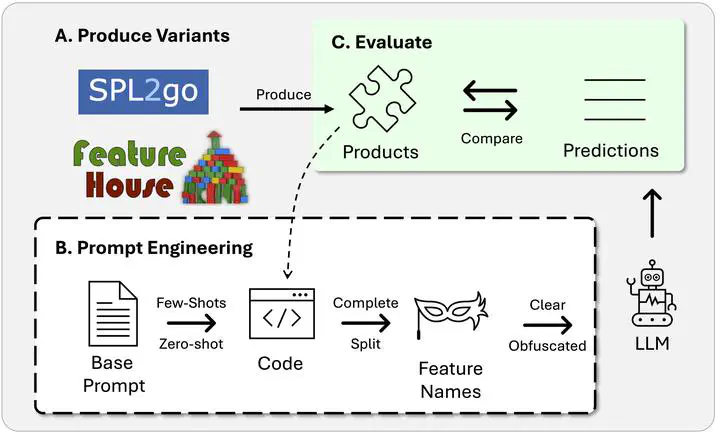
 Approach overview
Abstract
Assessing legacy systems for compliance with new requirements is critical but hindered by obsolete documentation and the loss of expert knowledge. While Software Product Line (SPL) research excels at feature model reconstruction, identifying specific features within a single legacy product for re-evaluation remains a persistent challenge and has received comparatively less attention than full feature model reconstruction. In this paper, we evaluate the ability of five Large Language Models (LLMs) to automate feature retrieval from legacy code. We propose an empirical framework using SPL benchmarks across 248 product variants to enable a controlled quantitative evaluation. Our study investigates the impact of prompting strategies, including few-shot configuration, feature name obfuscation, and source code granularity (individual function definition vs. complete code). Our results demonstrate that while LLMs can identify features with reasonable accuracy, their performance is highly sensitive to lexical cues and prompting design. We highlight a fundamental Precision-Recall trade-off and provide empirical insights into the conditions and challenges of using LLMs for legacy system re-assessment.

Guillaume Nguyen
PhD Student

Xavier Devroey
Professor of Software Engineering
My research goal is to to ease software testing by exploring new paths to achieve a high level of automation for test case design, generation, selection, and prioritization. My main research interests include search-based and model-based software testing, test suite augmentation, DevOps, and variability-intensive systems.